

A soft-close hinge can look suitable on a product page and still feel wrong on a finished cabinet. The difference often appears when the sample is mounted on the actual door: the door may travel unevenly, the gap may vary, or the closing action may be different from what the buyer expected. For furniture manufacturers and cabinet buyers, a useful sample review therefore tests the whole door assembly, not an isolated hinge held in the hand.
LIJIALI's site lists several hinge categories and hinge dampers. Its Search Console export also shows existing searches for terms such as “buffer hinge” and “damping hinge.” Those queries show that the website is being discovered for the subject; they do not establish worldwide search volume. This guide addresses the next practical question: what to check before accepting a soft-close hinge sample for a particular cabinet design.
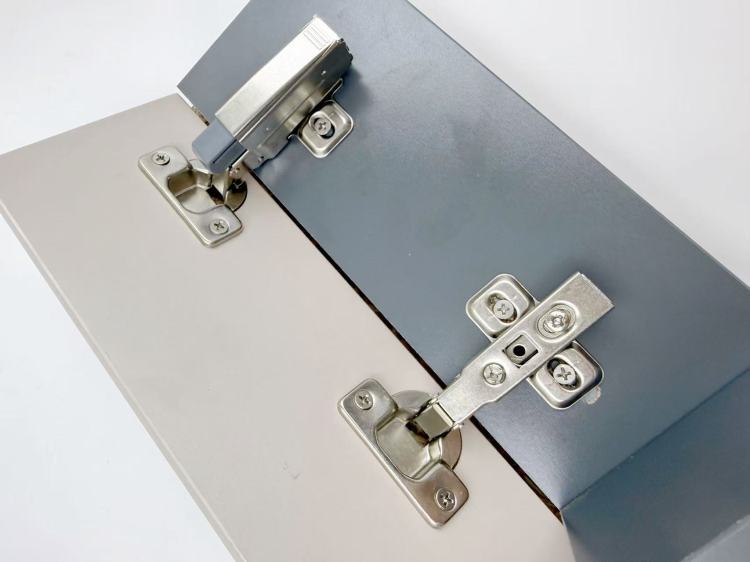
Quick answer: test the fitted door
Record the door construction, mounting method and desired opening action. Install the candidate hinge on a representative cabinet, adjust the door, then observe closing from several starting positions. Compare the feel, alignment and repeatability under the conditions the product will actually face. If the sample fails, identify whether the issue is the hinge, the mounting position, the door, or a combination before changing the specification.
A short, repeatable test is more useful than calling one hinge “better” without defining the cabinet and evaluation criteria.
Define the door assembly first
Start with door width, height, thickness, construction and approximate mass. Note whether the cabinet is framed or frameless, the intended overlay, and any restrictions around adjacent doors. A hinge intended for a standard wood door should not be assumed to suit an aluminum-frame door or an unusual front without checking the product drawing and mounting requirements.
Specify the number and positions of hinges according to the chosen product documentation and the door design. Do not infer a universal hinge count from another project. If an external damper is being considered, describe its location and compatibility separately; the presence of a damper does not automatically make every hinge and door combination equivalent.
Run a sample review in five steps
- Check fit: compare the hinge drawing with the door and cabinet measurements, including mounting positions and clearance.
- Install consistently: use the same representative panel and mounting method for candidates being compared.
- Align the front: adjust the door gap and face position before judging closing feel; misalignment can distort the result.
- Observe movement: open and close from several angles, noting whether the door catches, rebounds, stops short or closes with an unwanted impact.
- Repeat and record: document observations, sample identity and conditions so a later production sample can be checked against the same criteria.
For a project with particular durability, temperature or duty-cycle requirements, ask the supplier for the relevant test method and evidence. A visual sample check does not prove long-term performance.
Separate a hinge issue from an installation issue
If the door does not close cleanly, first check panel interference, cabinet squareness, mounting accuracy and gap adjustment. If the movement is inconsistent, compare the same hinge on a properly built reference cabinet. Record whether the problem occurs at every opening position or only near the end of travel. These observations make a supplier discussion more precise.
If the design uses push-to-open operation, review that function as its own requirement. Soft closing and touch opening are different actions; the exact combination must be confirmed for the selected hardware rather than assumed from a product family name.
Choose the right LIJIALI starting point
The site's slide-on soft-close hinge and clip-on soft-close hinge categories provide starting points for the mounting approach. The hinge damper category is relevant when the closing mechanism is being evaluated separately. The final choice depends on the actual product specification and cabinet assembly.
Existing LIJIALI articles explain what damping hinges are and compare broad hinge types. This checklist focuses on evaluating a physical sample against a defined cabinet, so it should link to those educational pages rather than repeat their explanations.
What to send with a hinge RFQ
- Door drawings, material, size and approximate mass.
- Cabinet type, overlay and desired opening angle.
- Expected closing and, if applicable, opening behavior.
- Installation method and production constraints.
- Photos or a short video of a current problem, if this is a replacement project.
- Required sample, test evidence and approval criteria.
Keep the acceptance criteria visible to engineering and purchasing teams. If a supplier proposes an alternative hinge, retest it on the same cabinet rather than comparing catalog claims alone.
Frequently asked questions
Can closing feel be judged before installation?
Only partly. The fitted door, mounting and adjustment all affect the result. A representative sample assembly is the more useful decision point.
Does a hinge damper fit every hinge?
Do not assume so. Confirm the damper's intended hinge, mounting position and door conditions with the supplier's documentation.
What if a sample closes unevenly?
Record the symptom and check geometry, interference and adjustment first. If the issue remains, share the conditions and observations with the supplier for review.
For a sample recommendation, review the relevant hinge damper options and send LIJIALI your door and cabinet drawings.